
Eagle County Court Records After a Jail Arrest
Eagle County criminal cases are handled in Colorado's 5th Judicial District. After an arrest, the person is booked at the Eagle County Detention Facility, and the Jail Viewer may list the original booking charge, arrest agency, court case number, next court date, and bond fields. That booking entry is not the final court record. The formal court records after a jail arrest are maintained by Eagle Combined Courts once the prosecution side files or proceeds on the charge.
The prosecutor for Eagle County is the Office of the District Attorney for Colorado's Fifth Judicial District. DA Heidi McCollum's office serves Clear Creek, Summit, Eagle, and Lake counties, and the Eagle office is at 955 Chambers Ave, Eagle, CO, with mailing at P.O. Box 295, Eagle, CO 81631. The DA decides what formal charges to file after arrest, so a charge shown on the jail roster can be different from the complaint or information that later appears in court records. For the custody side, use jail inmate records. For booking photos, use jail mugshots. For filed charges, docket events, registers of action, dispositions, and certified copies, use Eagle Combined Courts.
How to Find Eagle County Court Records After an Arrest
The official Colorado Judicial Branch docket search is the starting place for hearing schedules and docket activity. It is not a document-copy portal, and it requires a date range plus at least one additional filter. For Eagle County, useful filters include 5th Judicial District, Eagle County, Eagle County Justice Center, Eagle County - El Jebel, court type, party name, attorney information, or case-number fields such as year, class, and sequence.
- Open the Colorado Judicial Branch docket search and set a date range, such as today, one week, one month, three months, six months, or a specific date.
- Add an Eagle County filter, party name, attorney, case class, case sequence, or courthouse filter so the search is narrow enough to run.
- Use the court case number from the Jail Viewer if it appears, but treat the booking date as custody timing, not the court filing date.
- Check the hearing listing against Eagle Combined Courts when a bond, court appearance, or filing deadline matters, because schedules can change quickly.
For document copies, use the Eagle County Judicial Branch records request page or email EagleRecordsRequest@judicial.state.co.us. Eagle Combined Courts can be reached at 970-328-6373. The Justice Center is listed at 885 Chambers Ave, P.O. Box 597, Eagle, CO 81631, and the El Jebel court location is at 20 Eagle County Drive, Suite B, Carbondale, CO 81623. Statewide criminal-history checks are a separate CBI process and should not be treated as official court-file copies.
The manifest screenshot for the Colorado Judicial Branch docket search shows why the search is filter-driven rather than a broad name-only database.
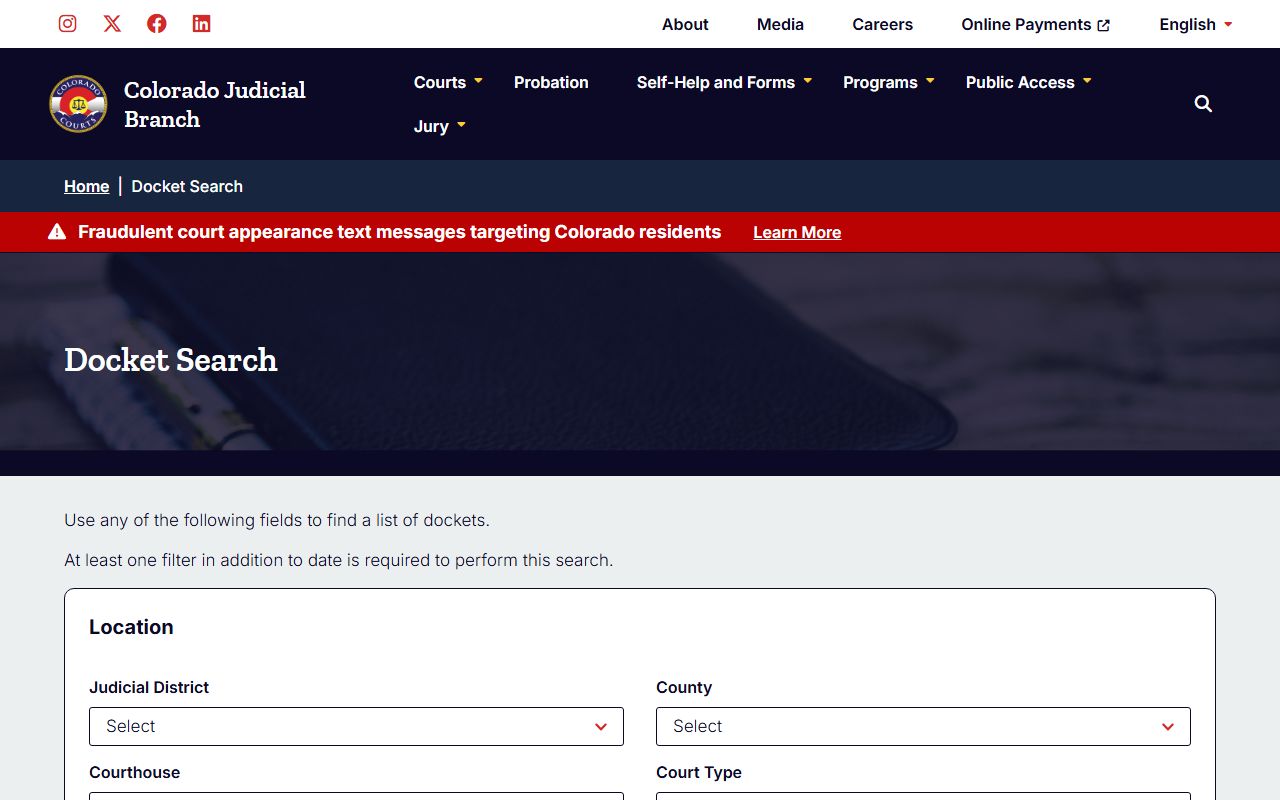
Use the docket screen to locate hearing activity, then move to the court record request process when the needed item is a complaint, information, disposition, sentence order, register of action, or certified document.
How Charges Get Filed After an Arrest: Complaint, Information, and Indictment
The arrest-to-court path in Eagle County usually starts with an arresting agency booking the person at ECDF. Jail Viewer may show original arrest charges, violation text, warrant fields, arrest agency case numbers, and required bond or bail amounts. The court charge record begins when the Fifth Judicial District Attorney proceeds with formal charges. Colorado Title 16 describes a charge as a formal written statement accusing a person of a crime, and the research identifies complaint, information, and indictment as the main charging-document terms.
| Complaint | Information | Indictment | |
|---|---|---|---|
| Filed By | Often an officer or prosecutor in county-court practice. | The district attorney, commonly for felony district-court filings. | A grand jury. |
| Common For | Misdemeanors, traffic, and lower-level criminal matters. | Many felonies and cases moving beyond early proceedings. | Serious or grand-jury-reviewed felony matters. |
| Starts | A formal court case or formal count after arrest. | A formal prosecution by the DA in court. | A court case based on a grand-jury accusation. |
Colorado law also recognizes points where the DA must file an information after certain preliminary-hearing or bind-over events, or file written reasons for not doing so. That is why a person may have a jail booking record before the final charge list in the court file is settled.
Charge Status in Court Records After an Arrest
Filed charges can change after the first booking entry. A violation listed in the jail viewer can be amended, reduced, dismissed, or replaced by a different filed count. A register of action is often useful because it summarizes charges, minute orders, hearings, and events in chronological form. A disposition or sentence order is the better source for the final outcome.
| Status | What It Means |
|---|---|
| Pending | The case or count is still active and has not reached final disposition. |
| Amended / Reduced | The prosecutor or court changed the filed charge, often after review, plea negotiation, or later court action. |
| Dismissed | The charge ended without a conviction on that count. |
| Disposition | The official final outcome, such as conviction, dismissal, deferred result, or sentence order. |
Bond and Release After an Arrest
Eagle County's detention materials give specific bond guidance. The jail information line, 970-328-8564, is the correct local number to confirm the type of bond required for a specific inmate. Bond is set according to a court-approved schedule and exists to assure future court appearance. Weekend bond hearings are scheduled for 8:45 a.m. and can be viewed through the Colorado Judicial live stream for Bond Hearing Office 1. Weekday docket lists are also available through the live judicial docket resources.
The sheriff links online inmate bond payments through Point and Pay. The payment form is for Inmate Bonds and collects inmate name, amount, cardholder contact details, and credit or debit card information. After an online bond payment, the payer must call ECDF at 970-328-8564 for further processing. If the payer wants bond money returned after the case, the sheriff's FAQ says to call the jail and ask to be listed as a surety on the bond paperwork. Property bonds are handled through the court clerk during regular business hours, and Eagle Combined Courts can be reached at 970-328-6373 for that process.
| Bond Type | How It Works |
|---|---|
| Cash Bond | The full amount must be posted in cash and is returned by the court when required appearances are completed. |
| Surety Bond | A state-licensed bondsman posts the bond and may require a co-signer or collateral. |
| Personal Recognizance Bond | A judge may allow release on a signature promise to appear without money or property. |
| PR Bond with Co-signer | The judge may require a co-signer who is responsible with the defendant for the bond amount. |
| Property Bond | Equity in real property may be used, but it must be posted through the court clerk's office. |
A hold can prevent release even when one case has a bond. State jail data categories include unsentenced people with holds, and research examples include parole holds, probation holds, another agency's detainer, federal or immigration holds, and other criminal-justice agency holds.
Warrants That Lead to an Arrest
No official public Eagle County active-warrant search was located in the research. Avoid third-party warrant pages for decisions about surrender, bond, or payment. Official paths are Eagle County Sheriff's Office at 970-328-8500, the jail information line at 970-328-8564 if the warrant has resulted in booking, Eagle Combined Courts at 970-328-6373 for case or docket questions, the Colorado Judicial Branch docket search, and legal counsel.
When a warrant leads to arrest, law enforcement books the person into ECDF. Jail Viewer may show a warrant number field, booking charge, arrest agency, court case number, bond or bail, and custody status. Court records then show the formal case activity and hearing schedule. Colorado law defines a warrant as a written order from a judge of a court of record to a peace officer commanding arrest of the named or described person, and state policy favors summons instead of warrant for many lower-level offenses unless safety or flight concerns exist.
Requesting Official Eagle County Court Records
The court request process is separate from the jail roster. The official request form can be used for complaint or information documents, disposition or sentence orders, protection orders, tickets, registers of action, certified copies, exemplified copies, and other identified court records. Helpful identifiers include case number, case type, filing year, county or location of record, party names, date of birth, and the specific documents requested.
Fees listed on the Eagle Combined Courts request form include copies at $0.25 per page, photographic copies at $0.75 per page, certified or exemplified copies at $20 per document, a $5 non-party search fee including register of action, and research or redaction after the first hour at $30 per hour billed in 15-minute increments. The form says to allow 3-5 business days for response. Mail requests to Eagle Combined Courts, Attn: Records, P.O. Box 597, Eagle, CO 81631, or use the court record email address above. The form also lists fax 970-328-6328 and phone 970-328-6373.
The manifest image from the Colorado Judicial Branch public records access guide is relevant because vendor register-of-action data is not the same as an official court copy.
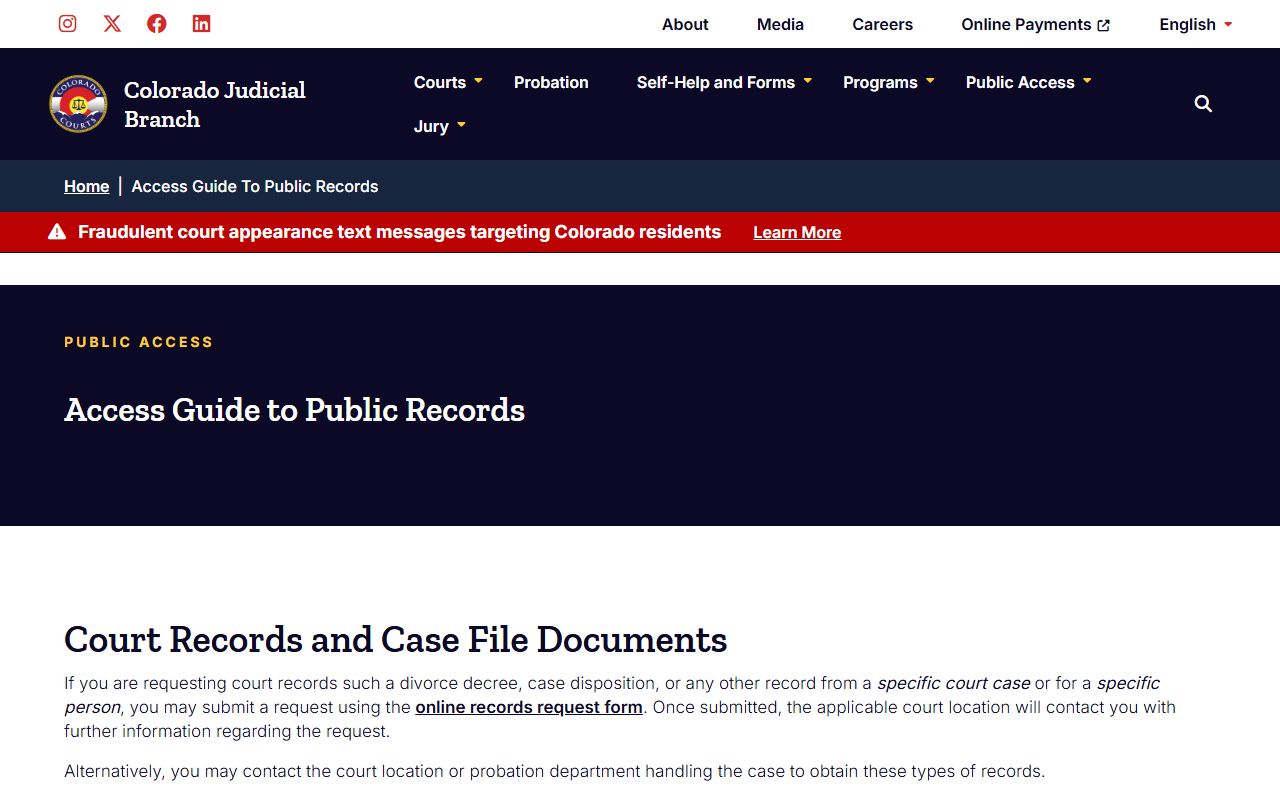
Use approved access tools for search leads, but request official copies from the court where the Eagle County case was filed.
Charges vs. Convictions
An arrest and a filed charge are accusations, not proof of guilt. Jail Viewer may list what the person was originally detained for, and the court file may later show different formal counts. A conviction appears only after a guilty plea, verdict, or other adjudicated guilty outcome. This matters for Eagle County court records after an arrest because search results can show a charge long before the case has a final disposition.
| Charge | Conviction | |
|---|---|---|
| Stage | Accusation or formal count after arrest. | Final guilty outcome by plea, verdict, or qualifying disposition. |
| Proof Level | Lower early-case standards and prosecutorial filing decisions. | Adjudicated result after the criminal process. |
| Public Record | Often public unless sealed, juvenile, or otherwise restricted. | Often public unless sealed, restricted, or controlled by law. |
Sealed vs. Expunged Arrest Records
Colorado criminal-record sealing is not the same as simply deleting a web result. CBI guidance directs people to petition through the court where the arrest or criminal records were filed, and Colorado sealing categories are addressed in C.R.S. 24-72-703 through 24-72-710. CBI no longer charges a sealing fee effective July 1, 2024, although court fees may still apply. A sealed record is restricted from ordinary public access and should not be released through routine public-record channels.
| Sealed | Expunged | |
|---|---|---|
| Visibility | Restricted from ordinary public inspection. | Treated more completely as removed where the law authorizes that remedy. |
| Law Enforcement | May remain available for limited official purposes. | Access depends on the specific Colorado remedy and order. |
| Eligibility | Depends on case type, disposition, waiting period, and court order. | Usually narrower and controlled by specific statutes or juvenile rules. |
Background Check Considerations
Colorado criminal-history checks are a different channel from Eagle County court copies. CBI's Internet Criminal History Check is the official statewide public background-check route for CBI records, but CBI can only release records it maintains. It does not replace an Eagle Combined Courts register of action, disposition, sentence order, or complaint copy, and it does not guarantee that every local agency file appears in a statewide search.
Important: This site is not a consumer reporting agency and cannot be used for FCRA-covered employment, tenant, credit, or insurance screening.
Restricted Court Records After an Arrest in Eagle County
Colorado public access has limits. The Colorado Criminal Justice Records Act covers criminal-justice records held by agencies such as sheriffs, police, prosecutors, and law-enforcement custodians. Records of official actions are generally open unless restricted, but inspection and copying can be denied or redacted when contrary law, public interest, safety, privacy, investigative sensitivity, juvenile status, sealing, or other statutory limits apply. Court-controlled records should be requested from the court, not the jail.
For Eagle County, the practical route is to match the record to the custodian. Current custody starts with the Jail Viewer or jail line. Booking photos and sheriff reports go through Eagle County Sheriff's Office records. Formal charges and final dispositions go through Eagle Combined Courts. Statewide Colorado arrest-history checks go through CBI. Federal custody goes through the BOP locator after designation, and immigration custody goes through ICE ODLS, neither of which replaces local court records after an Eagle County arrest.
The manifest screenshot from the Fifth Judicial District Attorney about page connects Eagle County charging decisions to the DA5 office led by Heidi McCollum.
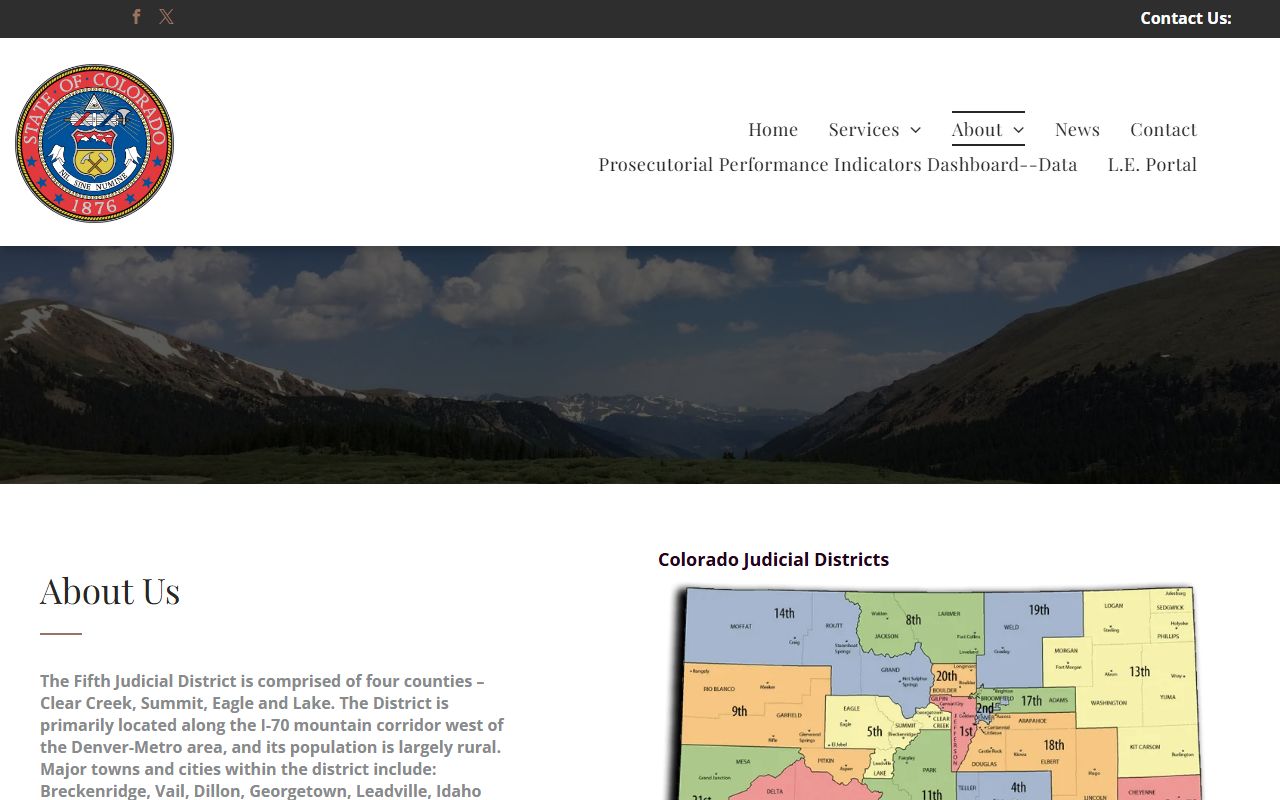
That prosecutor role is the hinge between a jail arrest and the formal court records that later show filed charges and case outcomes.